Tuesday, April 09, 2013

leadbeater's possum - situation critical

Pam Miskin, President of the Friends of Leadbeaters Possum,
Eric Wilkinson who rediscovered the species in 1961 and
Cr Samantha Dunn, keen to continue to highlight the plight of our
state emblem, the Leadbeater's Possum.
It was great to get up into the forests in Camberville behind Melbourne's water catchments as part of the Leadbeater's Possum Awareness Week. Leadbeater’s Possum is Victoria’s State Faunal emblem. An endangered species with both State and National Recovery Programs in place. Endemic to Victoria, they exist nowhere else but the Central Highlands forests, Yellingbo Nature Conservation Reserve and alpine areas between Lake Mountain & Mt. Baw Baw. 


Dave Blair assists Prof David Lindenmayer with his
research work in the Central Highlands forests.

Friends of Leadbeater's Possum organised a walk and talk led by David Blair, scientific researcher for Professor David Lindenmayer, world expert on Leadbeater's Possum.


Eric Wilkinson has many a tale to tell about rediscovering
Leadbeater's Possum, including the challenges of
photographing his discovery with old bulb flash technology.

It was wonderful to hear from Eric Wilkinson, who rediscovered the possum in on the 3rd April, 1961. Eric retold his tales of exploring the region in his Hillman Minx as a 22 year old and his amazement that he had seen a Leadbeater's Possum, at the time, thought to have been extinct.


David Blair led the group on a walk through both intact, burnt and severely burned forests and explained the importance of large old trees to this species and the many threats to this species including fire and logging.


People came from near and far to learn more about
the Central Highlands forests, home to Leadbeater's Possum.

Population estimates for Leadbeater's Possum prior to the 2009 bushfires were around 2,000-2,500 individuals, post-fire estimates are at around 800. Approximately 40-50% of their prime habitat was lost in the fires whilst what is left is often logged, the legislation in place to protect the species, weak, currently being contested in the MyEnvironment v VicForests Supreme Court Appeal.


Even as part of his judgement Justice Robert Osborn said, "MyEnvironment has demonstrated a strong case for the overall review of the adequacy of the reserve system intended to protect LBP habitat within the Central Highlands Forest Management Area. The [2009] bushfires have materially changed the circumstances in which the existing system was planned and implemented and there is, on the evidence, an urgent need to review it".


The future of Leadbeater's Possum is dire, a recent article in New Matilda highlights the proposed watering down of legislation to protect this species, the Victorian State government has since backed away from these changes, highlighted in a story in today's Age.

Back in September last year, Prof David Lindenmayer resigned from the Leadbeater's Recovery Team in protest over policies which he said was managing the species into extinction. At the time Prof Lindenmayer said he could no longer work with "the most environmentally bankrupt administration". You can read more about it in this Age article.     

In the state of Victoria Leadbeater’s Possum is listed under the Victorian Flora and Fauna Guarantee Act 1988 as threatened.

In Australia Leadbeater’s Possum is listed under the Environment Protection & Biodiversity Conservation (EPBC) Act 1999 as endangered.

The IUCN (International Union for the Conservation of Nature) Red List of Threatened Animals 1994 lists Leadbeater’s Possum as endangered.

Logging of the Mountain Ash forests in the Central Highlands for woodchips (paper production) has resulted in the loss of vast areas of Leadbeater’s Possum habitat. Prof Lindenmayer says our forests are being overcut, so there'll be no habitat left for Leadbeater's Possum into the future.

The fragmentation of suitable habitat by timber harvesting causes isolated small populations of animals, who are then unable to reach other colonies for breeding.

Other events, such as bushfires, disease, drought (climate change) and collapsing old habitat trees are also threatening processes for Leadbeater’s Possum.

It is a crisis and we have to ask ourselves as Victorians, do we accept watching on as this species, our state emblem, teeters on the brink of extinction.

If you'd like to help Friends of Leadbeater's Possum in their efforts you can find out more about them here. My congratulations to the group, it was sobering to learn more about the perilous situation Leadbeater's Possum are in and I'll be doing my utmost to continue to highlight their plight.


Labels: , , , , ,

Tuesday, April 19, 2011

yarra ranges submits to vicforest timber release plan

Yarra Ranges Council recently met with representatives of VicForests to talk about their current Timber Release Plan. As a result of talks Yarra Ranges prepared a submission to VicForests.

Council has a number of general concerns but some of our more specific concerns include:
Logging in Water Catchments - Council does not support any logging in closed or open water catchments, back in November 2007, I moved a motion to oppose logging in water catchments which was supported unanimously. There are 86 coupes proposed for water catchments in the current timber release plan.
Impact of Logging on Tourism, Local Economy and Environment - In June 2010 Cr McRae moved a motion calling for the immediate halt of logging on the Bicentennial Trail and Mt St Leonards due to significant adverse impacts on the local economy, tourism features and the environment. Council continues to be concerned about the siting of coupes in sensitive tourism areas and coupes that impact on the significant landscapes of the shire, our vistas are very important and need to be protected. It is council's view that at least 11 proposed coupes will impact on prominent tourism areas.
Quality of Ecological Assessments - council continues to be concerned about the level of ecological assessment of logging coupes. Council believes, given the ecological significance and sensitivity of many flora and fauna in Yarra Ranges, that comprehensive ecological assessments are required for each coupe prior to approval by a someone who has suitable and specific ecological qualifications.
Post Logging Ecological Assessments - council believes that there is little or no data on the cumulative ecological effect of logging on our forests and that as a matter of course assessments should be conducted 6 months after a regeneration burn to assess the cumulative effect on biodiversity and regeneration success.
Retention of Habitat Trees - council believes the logging industry should apply the same standard to the identification of habitat trees that applies in the state government's Native Vegetation Management Framework. That way habitat trees would be identified using the sound science that underpins the NVMF rather than use a subjective in the field assessment of what constitutes a habitat tree.
Protection of Threatened Species Habitat - The extent of the 2009 bushfires had significant impact on the habitat of threatened species, particularly Leadbeater's Possum. Council wants assurances that no new coupes will be granted that have the potential to destroy Special Protection Zone forest or any areas of Leadbeaters Possums' Permanent Reserve System or other areas previously set aside to conserve and secure forest biodiversity. There are currently 21 proposed coupes adjacent to SPZ or LPPRS forest.
Regeneration of Logged Coupes - Council is concerned about the rate of regeneration of logged coupes. It is abundantly clear from recent reports that regeneration rates fall well below what is required and there is a growing backlog of logged coupes requiring regeneration. Council does not support the approval of any new coupes in the region until VicForests can clearly demonstrate their capacity, budget and commitment to address the backlog of regeneration.

There are a number of other issues too, including movement of logging trucks at night and on Sundays (through tourist towns), landscape fragmentation and habitat connectivity, value of timber products (which in the main are low grade woodchips, not high grade timber veneers) and monitoring and reporting of forest management. It's a complex issue which continues to impact on the Shire in many ways.

Our forests are more important than ever, in combating climate change as carbon sinks, protecting water supply for greater Melbourne as well as biodiversity, it's important to protect and conserve what's left.

Labels: , , , , , ,

Sunday, August 08, 2010

seeing the central highlands

Last week I toured some logging sites and forests in the Central Highlands. These photos capture some of the things I saw whilst out in the forests.

This is the edge of a logging coupe on Mt St Leonards, it’s this coupe that’s cuts a ‘tooth’ in the side of the mountain visible from Healesville. This logging galvanized residents to raise the alarm about logging on such a prominent site raising concerns about impact on biodiversity and tourism.

This is the Kalatha Giant, a massive tree spanning between 15 and 17 metres, there’s a logging coupe planned only 10 metres from this tree in Leadbeater’s Possum habitat in the North Western most place where this forest type grows.

This logging coupe is right in the midst of Leadbeater’s Possum habitat, very close to a monitoring site that’s been in place for decades.

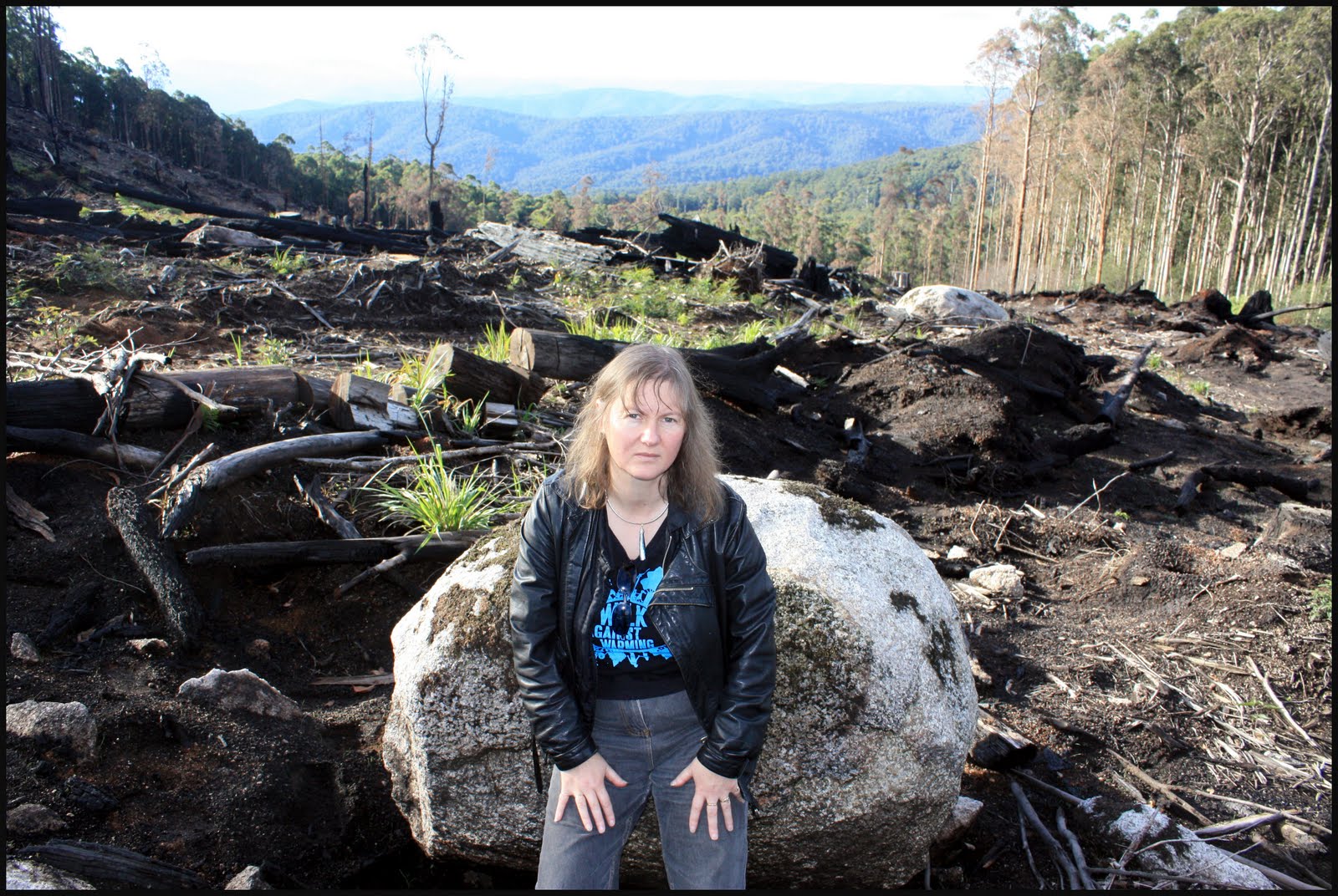
The people visible on the right hand side make it easier to understand the scale of damage to Leadbeater's Possum habitat.

You can tell by the size of the stumps left behind that these trees are much older than 1939 regrowth.

This is a logging coupe in the Armstrong Water Catchment. The Armstrong makes up part of Melbourne’s water supply, closed to the public, entry is prohibited to protect the integrity and quality of Melbourne’s water, yet this is allowed to happen.

Labels: , , , ,

Monday, May 24, 2010

logging costs us billions of litres

I recently toured the Central Highlands.

To read on visit

Samantha Dunn for Eastern Victoria

Labels: , , ,

Friday, May 21, 2010

logging in the central highlands

Last week I attended a roundtable with Environment Minister, Gavin Jennings, hosted by Tammy Lobato. It gave me the opportunity to raise some concerns about logging in the Central Highlands.

I talked to the Minister about the amount of salvage logging that has taken place in the last year. Since the bushfires last year, 715,000 m3 has been logged in Yarra Ranges and Murrundindi, double the intake of any standard year.

This is a logging coupe at Starvation Creek. Logging is changing the make up of our forests and increasing fire risk throughout the region.


Given the increase of logs available I to mills asked the Minister if the salvage wood currently in the supply chain is being delivered under deferred payment arrangements or at discounted rates?

I went on to talk about the audit process, my concern is that audits have not taken place since 2007 or if they have taken place they have not been made publicly available. This is contrary to the commitment to public transparency made by Minister Jenning’s predecessor, John Thwaites under the Our Forests Our Future policy. I went on to talk about concerns that the Auditor General no longer has the audit function as it will now be carried out by the Department of Treasury and Finance.

I also talked about the amount of logging trucks that are travelling laden on roads outside of the hours permitted (in accordance with the Code of Forests Practice). The code is specific in that trucks must not operate between dusk and dawn. At the roundtable I referred to a logging truck in Lilydale at 1:39am on Wednesday 12 May. I asked the Minister to clarify how the provisions of the Code of Practice are being enforced, as logging trucks on road late at night are a regular occurrence in Yarra Ranges.


Even this week, laden logging trucks were spotted on the road travelling in the wee small hours. This is an ongoing issue as it is commonplace to sight logging trucks operating in the dead of night and it will be good to get clarification on whether the code has been breached.

Community members took great interest in the roundtable and raised many far ranging environmental issues from the Climate Change White Paper, weeds, logging in water catchments, renewable energy, waterways and Container Deposit Legislation, to name a few. Local government also raised the issue of public street lighting and the cost impost of changing to more energy efficient lighting without any support from state government.

Labels: , ,

Wednesday, March 24, 2010

more logging coupes for central highlands

report from the roundtable – 23 mar
In my role as chairperson of the Yarra Ranges Environment Advisory Committee an issue was raised by a YREAC member concerning the proposed harvesting plan amendments in VicForest’s Timber Release Plan 2010.

Once alerted to the amendments I moved the following motion:
That council forwards a submission to Vic Forests with regard to the proposed Harvesting Plan Amendments in the Timber Release Plan 2010 before the 8th April, 2010, expressing its concern about the proposed 148 additional coupes and road lines within the central highlands region.

And that copies of the submission be forwarded to The Hon. Gavin Jennings MP, Minister for Environment and Climate Change, Mr Greg Wilson - Secretary DSE, Mr Kevin Love - DSE Deputy Secretary, Public Land Stewardship and Biodiversity, Mr Michael Crutchfield MP, Parliamentary Secretary for Water & Environment Ms Tammy Lobato MP, Member for Gembrook and Mr Ben Hardman MP, Member for Seymour.

Vic Forests are currently applying for an additional 148 new couples and road lines in the central highlands of Victoria. This is a matter of some urgency as public comment is invited up to the 8th April, 2010 and that’s why I moved quickly to bring it before council.

The locations of the proposed new coupes affect the areas of Powelltown, Toolangi and Marysville. Council is already opposed to logging of Melbourne’s water catchments and in talking to the motion I raised issues around these proposed amendments to logging coupes as excessive and unsustainable.


Toolangi was hit hard by the Black Saturday bushfires yet it appears 25% of the available forest is proposed for logging in the next year or two.


The unsustainable nature of current logging of the Central Highlands is evidenced in the DSE’s Monitoring Annual Harvesting Report which shows that in the central region
there is an 87% backlog in coupe regeneration after harvesting, whilst there is a significant number of coupes that are overdue for stocking surveys. Regeneration is clearly not keeping pace with logging activities. Whilst a massive regeneration backlog exists additional coupes should not be approved. The massive backlog clearly indicates how unsustainable current logging and regeneration practices are.

With climate change, a changed lower rainfall pattern is projected. With diminished quantity and reliability of water successful regeneration of logged coupes cannot be guaranteed. Under these scenarios germination and establishment failures will be more commonplace.

The maps supplied by VicForests to indicate the proposed new coupes fail to show them alongside other coupes previously approved or about to be logged. When these new coupes are overlaid with the current coupes the amount of forest to be logged is substantial.
.
The proposed areas under consideration have not been properly surveyed, particularly after the Black Saturday bushfires and the extent of damage to wildlife, including endangered species, such as the Leadbeater’s Possum are unknown. The forests were significantly disturbed by the 2009 fires, time must be given to them to allow them to recover and regenerate naturally as far as possible, the compounding affects of logging these areas will create further disturbance in an already fragile environment.

Clarification needs to be sought as it appears that some of the proposed coupes include designated Special Protection Zones, where logging is not permitted.

Much work has been done on the economic recovery of these areas and it has been recognised that attracting nature based tourism activities will lead to the economic recovery of fire affected communities. Logging activities severely impact on the desirability of tourists to visit the region.

Already the water yield of the forests has been diminished in quantity and quality by the recent bushfires, logging these areas will exacerbate these water issues for decades to come. Recent research indicates that the industrial logging of wet forests has the potential to increase their susceptibility to more fires into the future.

Forests into the future will have a far greater value as a tool to mitigate climate change and play a key role as carbon sinks. Research has shown that the Mountain Ash forests of the central highlands have the highest carbon carrying capacity of any forest in the world.

Yarra Ranges is highly valued for its natural environment, it is of key importance to our community and comes up time and time again as one of the key reasons young and old alike love living in Yarra Ranges. Our natural environment attracts millions of visitors every year.

Responding to this request for public comment is an opportunity for the shire to articulate this vision and aspiration. Our forests have far more value left standing and intact than being logged for woodchips. The motion was won.

Labels: , ,

eXTReMe Tracker